


Busitema University Researchers Develop Solar-Powered Smart Integrated Cadmium Telluride Greenhouse for Sustainable Tomato Production in Uganda
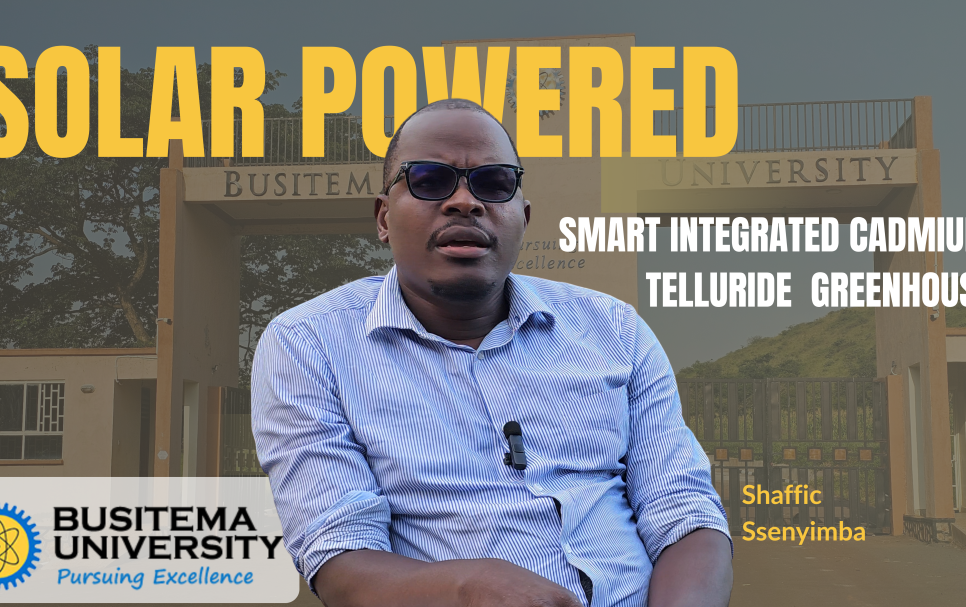
As climate change continues to reshape agricultural production across Uganda and many parts of sub-Saharan Africa, the need for innovative farming solutions has never been greater. Rising temperatures, unpredictable rainfall patterns, prolonged dry spells, and increasing pressure on natural resources are creating significant challenges for farmers, particularly those involved in horticultural production. Tomatoes, one of the most widely grown and economically important vegetable crops in Uganda, are especially vulnerable to fluctuations in temperature, humidity, and water availability. Recognizing these challenges, a team of researchers from Busitema University has developed and evaluated an innovative solar-powered smart Semi-transparent Cadmium Telluride (ST-CdTe) greenhouse designed to create optimal growing conditions for tomato production while reducing energy and water demands.
The research, led by Shaffic Ssenyimba together with Samson Rwahwire, Nibikora Ildephonse, Joseph Ddumba Lwanyaga, Peter Tumutegyereize, and Wilson Babu Musinguzi, investigated the performance of a Cadmium Telluride (CdTe) photovoltaic-integrated greenhouse under Ugandan conditions. The study sought to address a growing challenge in controlled-environment agriculture (CEA): how to maintain suitable greenhouse temperatures and airflow while minimizing energy consumption and ensuring sustainable operation.
Greenhouse cultivation has become increasingly important as farmers seek ways to protect crops from adverse weather conditions and improve productivity. Traditional greenhouses allow growers to regulate environmental conditions such as temperature, humidity, and irrigation, enabling year-round production and reducing the risks associated with climate variability. However, these systems often require significant amounts of energy to operate ventilation, cooling, heating, and irrigation equipment. In many developing countries, access to affordable and reliable energy remains a challenge, limiting the adoption of greenhouse technologies among farmers.
To overcome this limitation, the Busitema University research team explored the integration of semi-transparent Cadmium Telluride photovoltaic panels into greenhouse structures. Unlike conventional solar panels that completely block sunlight, these specialized photovoltaic modules generate electricity while still allowing sufficient light (Photosynthetically active radiation) to pass through for crop growth. This dual-purpose approach enables the greenhouse to function both as a food production facility and a renewable energy generation system.
The greenhouse prototype was designed, fabricated, and installed at Busitema University in Busia District, an area characterized by abundant solar radiation and climatic conditions representative of many agricultural regions in Uganda. The structure is a gable greenhouse measuring 3.6 metres in length, 2.25 metres in width, 2 metres in height, and a roof pitch of 20°. The design incorporated photovoltaic roof glazing, side-wall polycarbonate panels, automated ventilation, irrigation, humidification, and pneumatic systems, environmental monitoring equipment, system controls and IoT components. The researchers aimed to develop an ST-CdTe integrated greenhouse technology for tomato production by conducting a spatio-temporal sun path and energy optimization analysis, designing and numerically evaluating the natural, mechanical, and hybrid ventilation systems, fabricating and commissioning a functional CdTe greenhouse prototype, and investigating how different CdTe transmittance levels affect microclimate, thermal behavior, energy generation, and cooling demand. They also assessed the physiological response and agronomic yield of two tomato varieties (Money maker and Tengeru) under varying transmittance conditions to establish the optimal balance between light transmission and energy generation.
To evaluate the greenhouse performance, the research team employed Computational Fluid Dynamics (CFD), a sophisticated engineering simulation technique used to model airflow, heat transfer, and environmental conditions within enclosed spaces. CFD has become an increasingly valuable tool in engineering because it allows researchers to assess system performance under different operating conditions before large-scale implementation. Through these simulations, the team examined three distinct ventilation approaches: natural ventilation, mechanical ventilation, and hybrid ventilation.
Natural ventilation relied on strategically positioned roof and side vents that allowed air to circulate through the greenhouse using wind and buoyancy effects. Mechanical ventilation used electrically powered fans to force air movement through the structure. The hybrid system combined both approaches, utilizing natural airflow pathways while supplementing them with controlled mechanical ventilation to improve environmental regulation.
The researchers developed a three-dimensional simulation model using SolidWorks Flow Simulation and then validated the model through experimental testing using the physical greenhouse prototype. This validation process was particularly important because it ensured that the simulated results accurately reflected real-world conditions. The comparison between simulated and measured temperatures demonstrated strong agreement, confirming the reliability of the computational model and providing confidence in the findings.
The study revealed notable differences in performance among the three ventilation strategies. While natural ventilation provided an energy-efficient means of air exchange, its effectiveness depended heavily on external weather conditions and wind patterns. Mechanical ventilation offered greater control over airflow but required additional electrical energy to operate. The hybrid system emerged as the most effective solution, combining the advantages of both approaches while minimizing their individual limitations.
According to the findings, the hybrid ventilation configuration-maintained greenhouse temperatures within the optimal range of 21°C to 27°C required for tomato production. This temperature range is particularly important because excessive heat can negatively affect pollination, fruit development, and overall crop performance. The hybrid system also promoted more uniform airflow distribution throughout the greenhouse, reducing temperature variations and creating a more stable growing environment for the plants.
Beyond ventilation performance, the research examined the greenhouse's water and energy requirements. The team designed a precision irrigation system tailored to the needs of tomato plants grown under controlled conditions. Based on crop water demand calculations and greenhouse dimensions, the study estimated that approximately 44 litres of water per day would be required to support 24 tomato plants. To maximize water-use efficiency, the system employed pulse irrigation cycles that delivered water in smaller, controlled quantities throughout the day rather than through a single large application.
The researchers also assessed the greenhouse's heating requirements under different environmental conditions. Their analysis showed that stable tomato production could be maintained using a heating capacity of approximately 0.5 kilowatts. This relatively modest energy requirement demonstrates the effectiveness of the greenhouse design in maintaining favorable growing conditions while limiting energy consumption.
An important aspect of the study was the integration of renewable energy generation into the greenhouse structure itself. The CdTe photovoltaic panels contributed to the greenhouse's electrical energy needs by generating power from sunlight while simultaneously serving as part of the greenhouse envelope. The researchers further evaluated the solar energy system requirements needed to support environmental control equipment, including ventilation fans, irrigation systems, humidifiers, and monitoring devices. Their findings indicate that photovoltaic-integrated greenhouse systems have significant potential to support energy-efficient agricultural production in regions with strong solar resources.
The researchers also analyzed two CdTe transmittance levels (60% and 70%) as roof glazing with clear polycarbonate as a control treatment. Their findings were striking. The 60% CdTe roof kept the greenhouse more than 4℃ cooler than the polycarbonate control on average and reduced the peak cooling energy demand by nearly 69%. They generated enough electricity of 1.8 kWh/day, as a daily mean surplus to what the greenhouse needed for operation, leaving a net energy surplus of almost 89% above consumption. It also kept the vapor pressure deficit (VPD) inside the greenhouse within the recommended threshold for tomato production, which was nearly 39% lower than the control treatment. This study demonstrates, for the first time in a field-validated equatorial setting, that it is technically possible to harness the solar intensity to generate clean electricity and protect crops at the same time using the same roof. A greenhouse that pays its own energy bills while keeping its plants cooler is not a marginal improvement. It is a structural solution to the food-energy crisis that defines smallholder agriculture in the tropics. If this technology is adopted at scale and supported by appropriate policy incentives, CdTe-integrated greenhouse technology could help close the productivity gap.
The significance of this research extends beyond the greenhouse prototype developed at Busitema University. As Uganda and many other countries continue to pursue strategies for enhancing food security and climate resilience, controlled-environment agriculture is increasingly being viewed as a promising approach for sustaining crop production under changing climatic conditions. The ability to combine renewable energy generation with precision environmental control offers opportunities to reduce operational costs, improve resource efficiency, and strengthen agricultural productivity.
The study contributes to a growing body of knowledge on sustainable agricultural technologies and demonstrates how engineering innovation can be applied to address practical challenges facing farmers. By integrating solar energy generation, advanced ventilation strategies, efficient irrigation systems, and computational modelling techniques, the research provides valuable insights into the design and operation of next-generation greenhouse systems suitable for tropical and semi-arid environments.
The findings also highlight the importance of interdisciplinary collaboration in solving complex development challenges. Bringing together expertise from chemical and process engineering, industrial engineering, water resources engineering, and renewable energy systems, the research exemplifies how diverse scientific disciplines can work together to develop solutions that support sustainable development goals.
As efforts continue to strengthen agricultural productivity and climate adaptation across Africa, innovations such as the photovoltaic-integrated greenhouse developed by Busitema University researchers demonstrate the potential of locally driven research to generate practical, scalable solutions. Through continued investigation, refinement, and field implementation, such technologies may play an increasingly important role in supporting sustainable food production and resilient agricultural systems for future generations.
- 474 views