


Busitema Researcher Presents Cross-Region Study on Crop Disease AI at EUVIP 2026

2 October 2026
Busitema Researcher Presents Cross-Region Study on Crop Disease AI at EUVIP 2026
Artificial intelligence can learn to recognise crop diseases with impressive accuracy, but a model that works well on familiar images may become less reliable when it encounters crops grown in another part of the world.
That problem was at the centre of research presented by Rosemary Nalwanga, a PhD candidate at Busitema University, at the 14th European Conference on Visual Information Processing, EUVIP 2026, held in Luxembourg from 28 September to 1 October.
Nalwanga presented the paper “Multi-Crop Leaf Disease Recognition: A Unified Benchmark and Cross-Region Study” as part of the conference programme on Vision for Earth and Space. The official EUVIP programme placed the work within an oral session devoted to applications of computer vision to challenges involving the Earth and space.
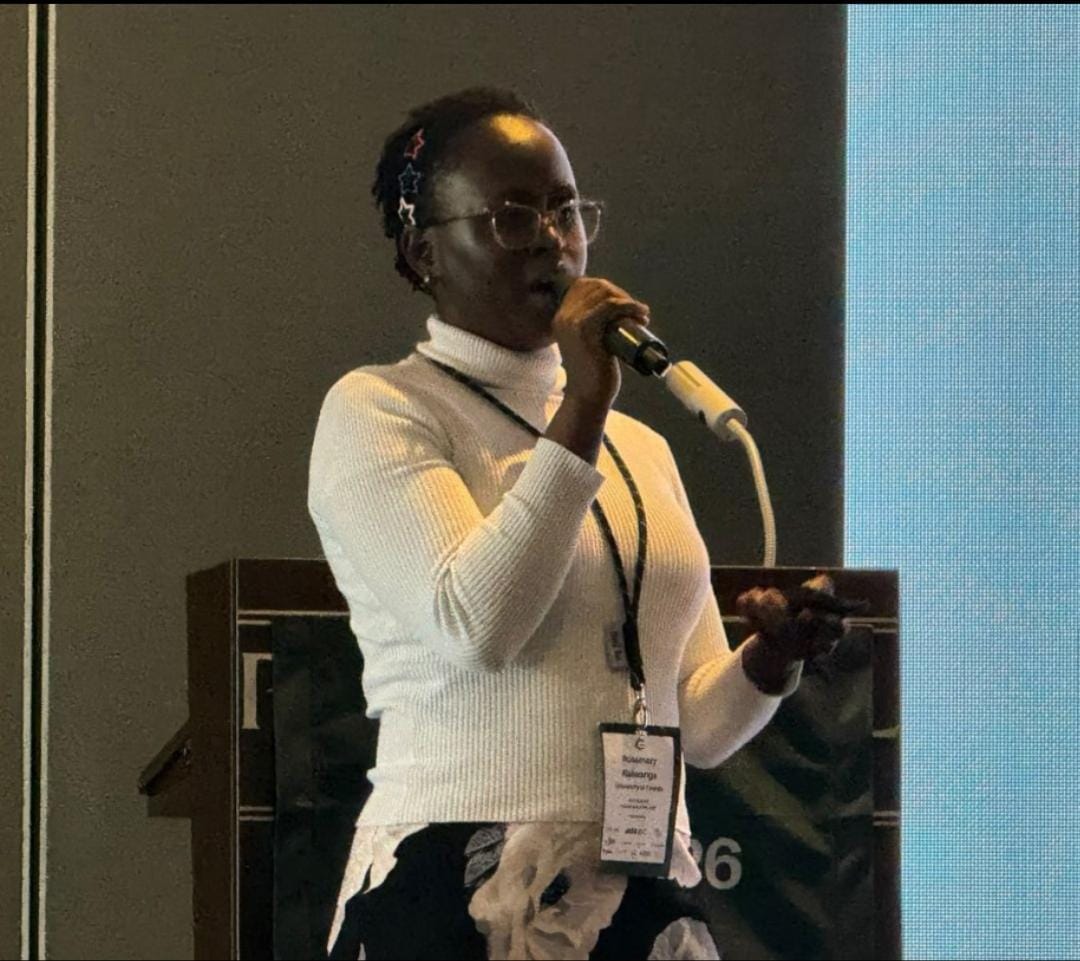
The study brings together crop leaf images from the United States, Asia and Africa to examine how well disease recognition models continue to perform when they are tested outside the geographical settings represented in their training data.
Training the models with more geographically diverse data improved their performance across regions, but a substantial gap remained. The result raises an important question for agricultural AI. A system may perform extremely well on data drawn from familiar conditions, but can that performance be maintained when the crop variety, climate, growing environment and other conditions change?
Nalwanga had raised the same concern ahead of the conference, noting publicly that models which perform exceptionally well within the environments represented in their training data can deteriorate when exposed to data from another region. She described the EUVIP paper as part of a wider effort to develop low-cost computer vision for multi-crop disease detection and recognition in resource-constrained farms.
The paper was co-authored by Rosemary Nalwanga, Sebastian Bunda, Luuk Spreeuwers, Godliver Owomugisha and Estefanía Talavera. The work is also listed among 2026 publications associated with the University of Twente's Data Management and Biometrics research community. Dr. Estefanía Talavera
Nalwanga’s presentation placed the study within a wider international conversation on visual information processing, bringing together researchers and practitioners working on how artificial intelligence can interpret and analyse images and other visual data.
The Luxembourg Convention Bureau, in its post-conference coverage, reported that EUVIP 2026 brought together participants from academia and industry across fields including deep learning, medical imaging, biometrics and forensics, Earth observation, autonomous systems, image restoration and visual AI. The four-day programme combined keynote talks, tutorials, oral and poster sessions, demonstrations, panel discussions and industry activities.
Within that wider discussion, Rosemary Nalwanga’s study, “Multi-Crop Leaf Disease Recognition: A Unified Benchmark and Cross-Region Study,” focused on a practical weakness in agricultural AI. Crop disease recognition models learn from collections of labelled leaf images, but strong results on familiar data do not always hold when those same models are tested on images from different regions and under different conditions.
Differences in crop varieties, growing environments and agricultural conditions can alter what a model encounters.
This concern had already emerged from earlier research by Nalwanga and her collaborators. In 2025, Nalwanga, Luuk Spreeuwers, Estefanía Talavera and Dr Godliver Owomugisha published “Multi-Crop Disease Detection in Computer Vision for Resource-Constrained Farms—A Review” in IEEE Access. The paper examined advances and remaining challenges in applying computer vision and machine learning to crop disease detection, with particular attention to multi-crop and resource-constrained farming environments.Among the problems identified were limited dataset diversity, poor model generalisation and insufficient testing under real-world conditions.
The authors paid particular attention to geographical variation. Their review noted that a model trained using data from one region may fail to perform equally well elsewhere because conditions such as climate, soils, crop varieties and farming practices vary from place to place. They argued for the inclusion of geographically diverse datasets when training crop disease recognition systems.
The EUVIP study takes that problem from review into experimental testing by bringing together leaf images representing Africa, Asia and the United States to examine what happens when disease recognition models move beyond the geographical conditions they already know. The findings show that training with more diverse data improves performance across regions, but the remaining gap indicates that broader data alone has not yet solved the challenge of building models that generalise reliably from one region to another.
The 2025 review observed that many crop disease recognition approaches remain focused on individual crops, even though intercropping is common among smallholder farmers in many developing regions. It also identified practical barriers including limited internet connectivity, the computing demands of some models and the difficulty of translating systems developed under controlled conditions into tools that can operate reliably in the field.
The authors called for more diverse datasets, lightweight models, offline-capable applications and stronger validation in actual farming environments.
The study builds on a broader line of research involving Busitema University’s AI and Interdisciplinary Research Group, BUAIIR, and the Data Management and Biometrics group at the University of Twente. Nalwanga is pursuing her PhD through this collaboration, while co-author Dr Godliver Owomugisha, Director of the BUAIIR Laboratory and a Senior Lecturer at Busitema University, has research interests in computer vision and machine learning for plant disease diagnosis.
The cross-region study now adds experimental evidence to that work. By showing that broader training data can improve performance without fully closing the gap between regions, it shifts attention from how well a model performs on a familiar dataset to how reliably it can work when conditions change.
That distinction becomes important when such systems move from research environments into farmers’ hands. An image-based diagnostic tool must be able to recognise disease in the crops and conditions it encounters in the field, even when those conditions differ from those represented in the data used to train it.
The work presented in Luxembourg brings the challenge into sharper focus. As crop disease recognition moves towards practical use, the real test will be whether models can maintain their performance across different regions, crop varieties and field conditions. The cross-region study shows that broader training data helps, but the remaining gap leaves researchers to build systems that farmers can rely on across conditions different from those used during training.
- 1 view