


Assoc. Prof. Egonyu Turns Soroti’s Organic Waste into Feed and Fertiliser
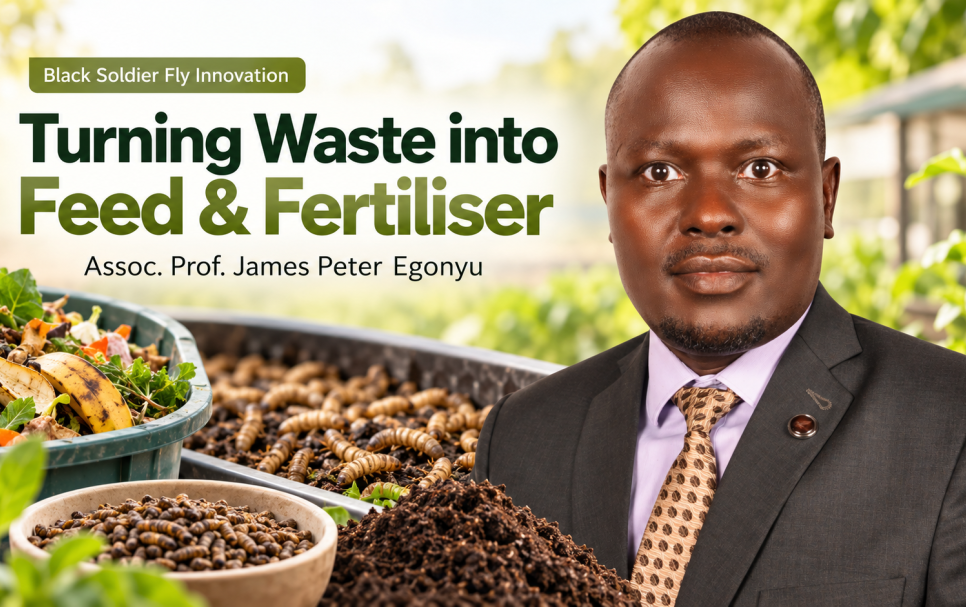
Assoc. Prof. Egonyu Turns Soroti’s Organic Waste into Feed and Fertiliser
27th September 2026
Soroti City generates about 165 tonnes of waste each day, and more than 70 per cent of it is organic, a volume of biodegradable material that Assoc. Prof. James Peter Egonyu’s work at Busitema University is seeking to put to use by raising Black Soldier Fly larvae for animal feed and turning the residue from the process into organic fertiliser.
Assoc. Prof. Egonyu brought that work to the 4th Busitema University Annual Science, Technology and Innovation Symposium, held in Soroti from 23 to 25 September 2026. His keynote, Turning Urban Organic Waste into Fertilizer and Animal Feed: Busitema University’s Black Soldier Fly Innovation, drew together several years of work by Busitema University on insect farming, waste recycling and the search for agricultural products that can be made from materials already available locally.
An Associate Professor of Agricultural Entomology at Arapai Campus, Egonyu has built part of his research around insects that can serve agriculture in more than one way. His interests include farming insects for food and feed, recycling waste into biofertiliser and crop pest management.
The Black Soldier Fly, Hermetia illucens, has become central to that work. Its larvae consume biodegradable material and grow rapidly on it. Once harvested, the larvae can provide a protein-rich ingredient for animal feed, while the residue from the feeding process, commonly called frass, can be used as fertiliser.
Busitema University has been testing how that process performs with the kinds of waste farmers and towns in Uganda actually have.
Under the project Commercialising Black Soldier Fly Farming for Livestock Feed and Organic Waste Recycling into Biofertilizer in Tororo and Soroti, rearing facilities were established at the Faculty of Agriculture and Animal Sciences in Arapai and the Faculty of Science and Education in Nagongera. By the time the project closed, 289 farmers from 54 districts had been trained, four farmers were reported to have adopted Black Soldier Fly farming, five students had taken part in research and two professional staff had received training.
Researchers wanted to know which locally available materials could support good larval production and what kind of fertiliser would remain afterwards. That led to trials using market food waste and brewers’ spent grain, together with studies of larval performance, the nutrient composition of the resulting frass and its use on vegetable crops.
The work also produced a draft paper titled Market Food Waste and Millet Spent Grain as Substrates for Producing Black Soldier Fly Larvae Meal and Biofertilizer. Busitema University’s project report records the manuscript as a draft intended for journal submission.
One product to come out of the project is BUINFERTZ, a Black Soldier Fly-based agricultural input developed by the University. Busitema’s account of the project lists the fertiliser among its major outputs alongside farmer training, student research and testing of local organic substrates.
In a peer-reviewed study published in the Journal of Insects as Food and Feed, Assoc. Prof. Egonyu joined researchers examining how Black Soldier Fly frass performed in maize production. The study compared the frass with mineral NPK fertiliser, compost made from brewers’ spent grain, a commercial organic fertiliser and untreated soil under greenhouse conditions.
Maize grown with Black Soldier Fly frass produced higher grain yields than maize grown with NPK, brewers’ spent grain compost and the commercial organic fertiliser at the rates tested. The researchers also found that combining frass with NPK produced the highest net income among the treatments they assessed.
Those findings help explain why Assoc. Prof. Egonyu’s work at Busitema has continued to follow both products coming out of the same process. The larvae have value as an ingredient for animal feed, but the material left behind can also return to crop production rather than becoming another waste product.
The Soroti work is now taking that idea into a larger urban setting. Through the Waste to Wealth project, known as WAWE, Busitema University and its partners are working with organic market waste in Soroti and exploring how it can be turned into animal feed and fertiliser while supporting businesses around collection and processing. The project also involves work in Nairobi and Kiambu in Kenya.
According to Assoc. Prof. Egonyu’s symposium presentation, Busitema University has established a model small-scale commercial Black Soldier Fly facility capable of processing about four tonnes of organic waste each week.
Four tonnes a week is still only a fraction of the organic waste Soroti produces, but it moves the discussion away from what Black Soldier Fly farming might do in theory. The University now has farmers who have been trained, facilities where the insects are reared, products being developed, student research coming out of the work and a city where the raw material is produced every day.
That is where Assoc. Prof. Egonyu’s keynote found its strongest connection with Soroti. The city has an organic waste problem, while farmers need affordable sources of feed and fertiliser. His research is bringing those two realities into the same conversation, using an insect to move material from one side to the other.
Instead of ending its usefulness in a market bin or waste collection point, part of Soroti’s organic waste could return to agriculture as feed for livestock and nutrients for crops. Assoc. Prof. Egonyu’s work is now concerned with whether that cycle can be made reliable enough, affordable enough and large enough to become part of how the city handles the waste it produces.
Read the research
Performance of Black Soldier Fly Frass Fertiliser on Maize (Zea mays L.) Growth, Yield, Nutritional Quality, and Economic Returns, published in the Journal of Insects as Food and Feed, Volume 8, Issue 2, pages 185–196. Brill
- 4 views